So, the year's closing out, and here I am wrapping up the year with the last (for now) installment in the Mario and Luigi series, Bowser's Inside Story.
This game was released for the DS in 2009, having been developed, like the other titles in this series, by AlphaDream. Like the other two games, this game stars Mario and Luigi. Unlike the other two, this game also features Bowser as a playable character.
As the game begins, the Mushroom Kingdom is beset by a plague called the Blorbs, with any toads infected swelling up to a ridiculous size. A meeting is called with Princess Peach and her advisers, including Mario and Luigi, and a representative from the stars, a young Star Sprite named Starlow. Bowser interrupts this meeting, claiming that he came to offer his help, but the sight of Mario infuriated him into attacking. After Mario trounces Bowser, Peach and Starlow send him flying away. Bowser lands in the woods, where a mysterious man gives him a mushroom that will give him the power to defeat Mario. The mushroom does that, but also temporarily brainwashes him. Bowser uses the power of the mushroom to suck up the toads in Peach's Castle, Peach herself, and Mario and Luigi, and the villain that gave Bowser the mushroom is revealed to be Fawful, from the first game. After sucking up everyone, Bowser is sent away by Fawful, and Bowser decides to get his revenge. Meanwhile, Mario and Luigi are inside Bowser, trying to find a way to get everyone out. All three have to work together, though Bowser never knows it, to stop Fawful.
In terms of gameplay, this game is very similar to the previous two titles in the series. Once more, everything Mario and Luigi do is done with the A and B buttons, and Bowser uses the X and Y buttons. This game still technically used Bros. Items for Mario and Luigi, but the attacks were done using points like the first game, instead of consuming items like the second. Like I said in my Partners in Time review, I prefer this, as it allows the player to have greater choice in what attacks they can use, so I am happy to see its return. Bowser, on the other hand, doesn't use items at all, instead utilizing his minions to perform special attacks. This goes from lighting Goombas on fire and launching them at the opponent, to having Shy Guys form a slingshot to fire Bowser at the enemy, to even using bouncing Koopa shells off of Bowser into the enemy. Bowser also keeps the ability he gained at the beginning of the game to suck up foes. Sometimes this heals him or gives him a stat boost, and sometimes it actually swallow his enemies, allowing Mario and Luigi to fight them from inside Bowser.
When it comes to the writing, this game is a lot like Superstar Saga. You go to many different locations across the Mushroom Kingdom, meeting various characters, few recurring, but many memorable, at least to some degree. Like Partners in Time, however, this game once more includes a Navi-like character in the Star Sprite named Starlow. Honestly, I found Starlow to be much more annoying than Stuffwell ever was, not seeming to do anything other than explain where I needed to go next, when most of the time, I figured that out without any help from her. I still don't see why they added either of these characters to the game, as they didn't do anything to progress the plot, nor were they entertaining, but I talked about that last week, so I don't feel like repeating myself too much.
Like I said earlier, Fawful has returned as the main villain of this game, much to my pleasure. I mean, much as I love other aspects of these games, Fawful remains my favorite part, and is probably one of my favorite characters of any game. Joining him as second-in-command in Midbus, a... pig-like monster who, like his boss, has a very strange way of speaking. I think I've heard it compared to an old kung-fu movie, and that's as good a comparison as any, I suppose. I haven't really seen any old kung-fu mvoies, so I can't say if it's accurate, but I digress.
All in all, this is probably my favorite game in the series. It's very well-made, the writing is fun, and I really don't have anything else to say. While I would recommend playing any of the games in this series, this is the one I'd recommend above the other two.
But, seriously, if you're only going to play one of them, play this one. Easily the best of the three.
And if you're not going to play any of them, still play this one. It's awesome. And Fawful's in it. Fawful is awesome.
So, yeah, that wraps up this review. See you next year, er, week, when I'll be back, same as normal.
Showing posts with label video games. Show all posts
Showing posts with label video games. Show all posts
Sunday, December 30, 2012

Sunday, December 23, 2012
Mario and Luigi: Partners in Time
Alright, second week of my look at the Mario and Luigi series. Here we are with Partners in Time, the 2005 sequel to Superstar Saga developed for the Nintendo DS. And that's all I've got for an intro.
In this game, Professor E. Gadd has invented time travel. And, instead of testing it himself or hiring someone to test it like a rational person might, he lets Princess Peach use it first. And, of course, she takes it back to when the Mushroom Kingdom was being invaded by aliens.
What, you didn't know that? Yeah, the Mushroom Kingdom was invaded by an alien race called the Shroobs, and when Peach found out about this, she decided she had to go back in time and get herself kidnapped by them, because they were about the only people that HADN'T kidnapped her yet. So when the time machine comes back sans Princess and with an angry alien, Mario must go rescue Peach. And Luigi comes with because he's in the title. Since the time machine (of course) doesn't work, they instead go through a hole in time and space that was opened by the time machine's usage.
Of course, that's only half of the story's intro. Shortly before the Shroobs invaded, Baby Mario and Baby Luigi were at Baby Peach's castle when Baby Bowser decided to babynap Baby Peach. Baby Mario stops Baby Bowser, but then the Shroobs attack, and all of the babies (plus a young-ish Toadsworth) flee in the Koopa Cruiser. It's at this point that they find the adult Mario and Luigi struggling to fight off some Shroobs, so Baby Mario and Baby Luigi go to their rescue. The adults decide to take the babies with them on their quest to rescue Peach, which may or may not be kidnapping, I'm not quite sure. Thus begins our adventure, with the four Mario bros. using various portals scattered across Peach's Castle in the present to visit different locales in the past, so that they can collect shards of the time machine's power source, the Cobalt Star, and use the reformed star to gain access to the past Peach's Castle and rescue the princess.
In many ways, this game is very similar to Superstar Saga. Battles are still turn-based, with Mario and Luigi using A and B, and the babies using X and Y, to attack and defend. The Bros. Attacks are changed a bit in this game, though. Instead of spending Bros. Points to use them, attacks are used by Bros. Items found throughout the game in blocks, or purchased in shops. I actually preferred using Bros. Points, since it allowed me to choose what attacks I wanted to use, instead of being limited by what items I had. However, there are a lot more choices for each of the brothers, and if there's one particular attack you grow fond of, you can use that with either brother, so that's a nice improvement. But generally, this game plays the same as the original, so that's definitely a point in its favor.
This game does suffer a bit in terms of writing, however. The plot is, like I said earlier, fairly standard, with Peach being kidnapped for the umpteenth time. But where Superstar Saga had a multitude of interesting characters, this game decided to have a few recurring characters, few of whom I felt were very interesting. I did like Kylie Koopa, a koopa (what else) with the personality of an old-school reporter, always looking for a big scoop. On the other hand, there was Stuffwell, who, in addition to holding the party's inventory, served as the game's Navi. And yes, he was just as annoying at times as she ever was. I'm not sure why he was in this game. Saga did perfectly fine without a character like this, so I don't know why they decided to add it in here. But, I'm griping. There weren't really any offensive characters, even if there weren't really any memorable ones, so I'm not really going to complain.
I will mention that Fawful has returned in a bit part as the owner of a shop where he trades beans that you can dig up for badges. In particular, you can trade 90 beans for an Ulti-Free badge, which gives the wearer unlimited uses of any Bros. Item. And if you're paying any attention, it's not that hard to find 90 beans by the endgame, so you should be going into the final boss fight with at least one of the brothers able to use as many Bros. Items as you want, which makes the fight a lot easier.
I'd also like to take a moment to talk about the music in this series. I neglected to mention it in the Superstar Saga review, but Yoko Shimomura (probably better known for her work in the Kingdom Hearts series) does a great job composing music in all three of these games. In particular, I love the final boss theme. It's a great song, and if I ever do a list of the best boss themes, feel free to give me crap if it doesn't show up on that list.
So, to wrap things up, this is a good game. Not really a great game, and definitely my least favorite in this series, but it's fun, and I would still recommend playing it.
As one last added note, the beginning of this game is actually the reason I decided to review this series this month in particular. The first area Mario and Luigi visit in the past is called Holli Jolli village. It's snowy, the mayor is a fat Toad you find stuck in a chimney, and the background music is a somewhat eerie arrangement of 'Jingle Bells.'
Also, when you reach the village, it is full of smoldering craters from a recent Shroob attack, and almost all of the villagers have been abducted by the Shroobs to have their life energy drained from them as a power source.
MERRY CHRISTMAS!
In this game, Professor E. Gadd has invented time travel. And, instead of testing it himself or hiring someone to test it like a rational person might, he lets Princess Peach use it first. And, of course, she takes it back to when the Mushroom Kingdom was being invaded by aliens.
What, you didn't know that? Yeah, the Mushroom Kingdom was invaded by an alien race called the Shroobs, and when Peach found out about this, she decided she had to go back in time and get herself kidnapped by them, because they were about the only people that HADN'T kidnapped her yet. So when the time machine comes back sans Princess and with an angry alien, Mario must go rescue Peach. And Luigi comes with because he's in the title. Since the time machine (of course) doesn't work, they instead go through a hole in time and space that was opened by the time machine's usage.
Of course, that's only half of the story's intro. Shortly before the Shroobs invaded, Baby Mario and Baby Luigi were at Baby Peach's castle when Baby Bowser decided to babynap Baby Peach. Baby Mario stops Baby Bowser, but then the Shroobs attack, and all of the babies (plus a young-ish Toadsworth) flee in the Koopa Cruiser. It's at this point that they find the adult Mario and Luigi struggling to fight off some Shroobs, so Baby Mario and Baby Luigi go to their rescue. The adults decide to take the babies with them on their quest to rescue Peach, which may or may not be kidnapping, I'm not quite sure. Thus begins our adventure, with the four Mario bros. using various portals scattered across Peach's Castle in the present to visit different locales in the past, so that they can collect shards of the time machine's power source, the Cobalt Star, and use the reformed star to gain access to the past Peach's Castle and rescue the princess.
In many ways, this game is very similar to Superstar Saga. Battles are still turn-based, with Mario and Luigi using A and B, and the babies using X and Y, to attack and defend. The Bros. Attacks are changed a bit in this game, though. Instead of spending Bros. Points to use them, attacks are used by Bros. Items found throughout the game in blocks, or purchased in shops. I actually preferred using Bros. Points, since it allowed me to choose what attacks I wanted to use, instead of being limited by what items I had. However, there are a lot more choices for each of the brothers, and if there's one particular attack you grow fond of, you can use that with either brother, so that's a nice improvement. But generally, this game plays the same as the original, so that's definitely a point in its favor.
This game does suffer a bit in terms of writing, however. The plot is, like I said earlier, fairly standard, with Peach being kidnapped for the umpteenth time. But where Superstar Saga had a multitude of interesting characters, this game decided to have a few recurring characters, few of whom I felt were very interesting. I did like Kylie Koopa, a koopa (what else) with the personality of an old-school reporter, always looking for a big scoop. On the other hand, there was Stuffwell, who, in addition to holding the party's inventory, served as the game's Navi. And yes, he was just as annoying at times as she ever was. I'm not sure why he was in this game. Saga did perfectly fine without a character like this, so I don't know why they decided to add it in here. But, I'm griping. There weren't really any offensive characters, even if there weren't really any memorable ones, so I'm not really going to complain.
I will mention that Fawful has returned in a bit part as the owner of a shop where he trades beans that you can dig up for badges. In particular, you can trade 90 beans for an Ulti-Free badge, which gives the wearer unlimited uses of any Bros. Item. And if you're paying any attention, it's not that hard to find 90 beans by the endgame, so you should be going into the final boss fight with at least one of the brothers able to use as many Bros. Items as you want, which makes the fight a lot easier.
I'd also like to take a moment to talk about the music in this series. I neglected to mention it in the Superstar Saga review, but Yoko Shimomura (probably better known for her work in the Kingdom Hearts series) does a great job composing music in all three of these games. In particular, I love the final boss theme. It's a great song, and if I ever do a list of the best boss themes, feel free to give me crap if it doesn't show up on that list.
So, to wrap things up, this is a good game. Not really a great game, and definitely my least favorite in this series, but it's fun, and I would still recommend playing it.
As one last added note, the beginning of this game is actually the reason I decided to review this series this month in particular. The first area Mario and Luigi visit in the past is called Holli Jolli village. It's snowy, the mayor is a fat Toad you find stuck in a chimney, and the background music is a somewhat eerie arrangement of 'Jingle Bells.'
Also, when you reach the village, it is full of smoldering craters from a recent Shroob attack, and almost all of the villagers have been abducted by the Shroobs to have their life energy drained from them as a power source.
MERRY CHRISTMAS!
Wednesday, December 19, 2012
Mario and Luigi: Superstar Saga
So, I originally planned on doing this review... almost 2 months ago now. Then I got distracted, then I did that thing for October, then... I did other stuff that wasn't reviewing this game. So, now it's December, almost Christmas in fact, and so I've decided to do some reviews all about the jolly fat man in red.
...Mario, of course, not Santa. Don't worry, you aren't the first to confuse the two. But we'll get to that later. Anyway, for the next three weeks (well, two and a half), I'll be doing a series of reviews on the Mario & Luigi games, starting by finally reviewing Superstar Saga.
Mario & Luigi: Superstar Saga was released for the Game Boy Advance on November 17th, 2003. It was the third Mario RPG released, after Super Mario RPG and Paper Mario. In this game, Princess Peach has not been kidnapped, surprisingly enough. Instead, her voice has been stolen... somehow. There's magic involved, that's all you really need to know. So Mario must journey to the neighboring Beanbean Kingdom in order to save Peach's voice. And, due to a wacky misunderstanding, Luigi comes along too.
This game is fairly basic when it comes to gameplay. In battle, Mario uses the A button for his commands, while Luigi uses the B button. They can attack individually, with Jump, Hammer, and Hand commands (Hand being elemental attacks, Mario using fire, Luigi using Lightning), or they can spend BP (Bros. Points) in order to pull off Bros. Attacks, powerful combination moves that require the player to enter the proper button sequence to deal maximum damage. Outside of battle, each of the brothers uses either the A or B button for commands, though this time it depends on the order in which they are standing, with the front-most brother using A, and the rear brother using B. The order can be switched using START, so that both of the brothers can use their abilities to their fullest. I only really have two complaints in this area: One, that the battles are a little too easy, but that could just be because I've played this game too many times; and Two, that the SELECT button is used to open the menu and the START button is used to switch the brothers instead of vice-versa, but that's just me being nit-picky. Overall, the gameplay in this game is solid and enjoyable.
My favorite aspect of this game, by far, is the writing. The story's more-or-less standard, the princess('s voice) has been kidnapped, and it's up to Mario (and Luigi) to save her (voice). But it's the details in what Mario and Luigi encounter in the Beanbean kingdom that make the game so much fun. You run into Hammerheaded Hammer-Makers that give you (What else?) hammers, an old man who ferments cola by telling it (truly awful) jokes, and a giant hermit crab with a lisp dressed as a Christmas tree who mistakes Mario for Santa Claus.

Yeah. Yeah, that's a thing that happens. But probably the best of all these characters is the main villain's cronie, Fawful. He is... incredibly strange, referring to people as 'finkrats' and making strange references to sandwiches. I don't understand a word that comes out of his mouth, but it's always fun to run into him.
This was probably my first (non-Pokemon) RPG, and remains to this day one of my favorites. This game, and its two sequels, are some of the few games that I make a point of replaying every year or so. So in case you couldn't guess, I'm strongly recommending you get this game and play it. Even if you aren't normally a fan of Mario, this is a great game.
...Mario, of course, not Santa. Don't worry, you aren't the first to confuse the two. But we'll get to that later. Anyway, for the next three weeks (well, two and a half), I'll be doing a series of reviews on the Mario & Luigi games, starting by finally reviewing Superstar Saga.
Mario & Luigi: Superstar Saga was released for the Game Boy Advance on November 17th, 2003. It was the third Mario RPG released, after Super Mario RPG and Paper Mario. In this game, Princess Peach has not been kidnapped, surprisingly enough. Instead, her voice has been stolen... somehow. There's magic involved, that's all you really need to know. So Mario must journey to the neighboring Beanbean Kingdom in order to save Peach's voice. And, due to a wacky misunderstanding, Luigi comes along too.
This game is fairly basic when it comes to gameplay. In battle, Mario uses the A button for his commands, while Luigi uses the B button. They can attack individually, with Jump, Hammer, and Hand commands (Hand being elemental attacks, Mario using fire, Luigi using Lightning), or they can spend BP (Bros. Points) in order to pull off Bros. Attacks, powerful combination moves that require the player to enter the proper button sequence to deal maximum damage. Outside of battle, each of the brothers uses either the A or B button for commands, though this time it depends on the order in which they are standing, with the front-most brother using A, and the rear brother using B. The order can be switched using START, so that both of the brothers can use their abilities to their fullest. I only really have two complaints in this area: One, that the battles are a little too easy, but that could just be because I've played this game too many times; and Two, that the SELECT button is used to open the menu and the START button is used to switch the brothers instead of vice-versa, but that's just me being nit-picky. Overall, the gameplay in this game is solid and enjoyable.
My favorite aspect of this game, by far, is the writing. The story's more-or-less standard, the princess('s voice) has been kidnapped, and it's up to Mario (and Luigi) to save her (voice). But it's the details in what Mario and Luigi encounter in the Beanbean kingdom that make the game so much fun. You run into Hammerheaded Hammer-Makers that give you (What else?) hammers, an old man who ferments cola by telling it (truly awful) jokes, and a giant hermit crab with a lisp dressed as a Christmas tree who mistakes Mario for Santa Claus.
Yeah. Yeah, that's a thing that happens. But probably the best of all these characters is the main villain's cronie, Fawful. He is... incredibly strange, referring to people as 'finkrats' and making strange references to sandwiches. I don't understand a word that comes out of his mouth, but it's always fun to run into him.
This was probably my first (non-Pokemon) RPG, and remains to this day one of my favorites. This game, and its two sequels, are some of the few games that I make a point of replaying every year or so. So in case you couldn't guess, I'm strongly recommending you get this game and play it. Even if you aren't normally a fan of Mario, this is a great game.
Tuesday, November 27, 2012
The Five Greatest Songs (From Games I've Never Played)
The music in video games has always been one of my favorite parts of playing a game. Hell, easily half of the songs on my MP3 player are either straight from a game, or a cover/remix of a song from a game. It's something that aids the storytelling process so well, and can help inspire the emotions the game is trying to convey. And so, loving video game music as I do, and not having a review ready this week, I've decided to do a list of some of my favorite video game songs. However, this is going to have a slight twist: This list will be completely composed of songs from games I have never played. And so, without further ado, the five greatest songs from games I've never played!
Note: As I've said before with these sort of posts, these are completely my opinions. There are a lot of games I've never played, and I'm sure there are some great songs I've missed. However, these are the ones that I've somehow managed to find and absolutely love.
5. Pursuit ~ Cornered (Phoenix Wright: Ace Attorney)
4. Blinded by Light (Final Fantasy XIII)
I have been a fan of the Final Fantasy series since I first picked up Final Fantasy IV a few years back. One of the things I loved about it was the beautiful soundtrack composed by Nobou Uematsu. However, he did not work on this game. Instead, I'm listening to 'Blinded by Light,' the Final Fantasy XIII battle theme composed by Masashi Hamauzu. Now, while it's true that I've never really heard any good things about this game, I love this theme. It has feeling of epicness to it that just makes for an amazing boss fight.
...Which is precisely why it isn't higher on the list. From what I understand*, this is the standard battle theme for this game. And I don't feel like that's where this song belongs. In fact, I could actually see this song getting annoying after a while. While it does have that feeling of epicness, that feeling should be saved for truly epic moments. It just doesn't feel right when you're listening to it while beating up nameless mooks.
3. You Will Know Our Names / Unfinished Battle (Xenoblade Chronicles)
Xenoblade Chronicles is probably my most-wanted game right now, and the soundtrack is no small part of it. Hell, 'Unfinished Battle' is the reason I first even heard of this game. I'm putting both of these songs in the number 3 spot because it felt unfair to have a single game represented twice on a five-entry list, but if it weren't for that, I'd take 'Pursuit ~ Cornered' off in a heartbeat to give both of these the spots they deserve. 'You Will Know Our Names' is the standard battle theme for the game, and it works really well as this. It gets the adrenaline pumping, giving the feeling of awesomeness without giving the impression that this should be saved for important events. Unlike 'Blinded by Light,' which I did enjoy, which I admitted could get annoying after a while, I would listen to 'You Will Know Our Names' looped indefinitely.
Now, I have no clue what 'Unfinished Business' is used for in-game, but I'm sure it's something big. It doesn't quite have the feeling of a boss battle theme, but at the same time, it does have this feeling of importance, the same sort of "Use this theme sparingly" quality that I felt in 'Blinded by Light.' And I'd be perfectly willing to wager that that's exactly how it's used.
2. Snake Eater (Metal Gear Solid 3)
Part of what makes this theme so great for me is the obvious James Bond homage. This feels exactly like a classic James Bond theme, which goes great to establish the setting of this game. And, honestly, I just love James Bond themes. They tend to have this really... grandiose feeling to them, and this song encapsulates this perfectly. Even the singer, Cythina Harrell, sounds like she stepped right out of one of those movies.
The only thing really, that keeps this out of the #1 spot is some of the lyrics. "Someday, you feed on a tree frog?" Really? I'm sorry, you just completely lost the feeling I was getting from you. I really have no clue what that was about, unless Snake does actually eat a tree frog in game, but even still, why talk about that in the song? I know, it's nit-picky, but it bugged me, and since this is my list, I can decide where these songs go.
1. Revived Power (Shadow of the Colossus)
Remember earlier when I said that boss themes should have this feeling of epicness, of importance, to them? Well, this song is EXACTLY what I was talking about. Kow Otani did a phenomenal job when composing this piece to accompany your battles with the Colossi. It honestly gives the feeling that you are fighting an enormous monster against impossible odds, but that you MUST somehow come out on top. From what I understand, I realize that this game has a bit of moral ambiguity to it, but as far as this song tells me, you are a paragon of virtue fighting insurmountable evil, but through the righteousness, you WILL prevail. And even if that's not true, I'd still love fighting the Colossi just to hear this song. This is easily the best song I've ever heard from a game I've never played.
Well, that wraps up this week's post. If you can think of any other awesome video game songs, feel free to tell me about. But, for now, this is me signing off until next week. See you then!
*Feel free to correct me if I'm wrong.
Note: As I've said before with these sort of posts, these are completely my opinions. There are a lot of games I've never played, and I'm sure there are some great songs I've missed. However, these are the ones that I've somehow managed to find and absolutely love.
5. Pursuit ~ Cornered (Phoenix Wright: Ace Attorney)
Despite my best efforts, the only game from this series that I've played so far is Apollo Justice. From everything I've seen, this looks like a great series. Good story, engaging puzzles, and most of all, a great soundtrack. And the song that stood out most to me was 'Pursuit ~ Cornered.' I love the feeling this song has. It gives off this impression of, "You just made a huge mistake, and I'm about to win!" that I love in video games. Much love to Masakazu Sugimori for being able to express this feeling so well in just about 45 seconds of music. To me, this is the epitome of comeback music, and for that, I love it.
4. Blinded by Light (Final Fantasy XIII)
I have been a fan of the Final Fantasy series since I first picked up Final Fantasy IV a few years back. One of the things I loved about it was the beautiful soundtrack composed by Nobou Uematsu. However, he did not work on this game. Instead, I'm listening to 'Blinded by Light,' the Final Fantasy XIII battle theme composed by Masashi Hamauzu. Now, while it's true that I've never really heard any good things about this game, I love this theme. It has feeling of epicness to it that just makes for an amazing boss fight.
...Which is precisely why it isn't higher on the list. From what I understand*, this is the standard battle theme for this game. And I don't feel like that's where this song belongs. In fact, I could actually see this song getting annoying after a while. While it does have that feeling of epicness, that feeling should be saved for truly epic moments. It just doesn't feel right when you're listening to it while beating up nameless mooks.
3. You Will Know Our Names / Unfinished Battle (Xenoblade Chronicles)
Xenoblade Chronicles is probably my most-wanted game right now, and the soundtrack is no small part of it. Hell, 'Unfinished Battle' is the reason I first even heard of this game. I'm putting both of these songs in the number 3 spot because it felt unfair to have a single game represented twice on a five-entry list, but if it weren't for that, I'd take 'Pursuit ~ Cornered' off in a heartbeat to give both of these the spots they deserve. 'You Will Know Our Names' is the standard battle theme for the game, and it works really well as this. It gets the adrenaline pumping, giving the feeling of awesomeness without giving the impression that this should be saved for important events. Unlike 'Blinded by Light,' which I did enjoy, which I admitted could get annoying after a while, I would listen to 'You Will Know Our Names' looped indefinitely.
Now, I have no clue what 'Unfinished Business' is used for in-game, but I'm sure it's something big. It doesn't quite have the feeling of a boss battle theme, but at the same time, it does have this feeling of importance, the same sort of "Use this theme sparingly" quality that I felt in 'Blinded by Light.' And I'd be perfectly willing to wager that that's exactly how it's used.
2. Snake Eater (Metal Gear Solid 3)
Part of what makes this theme so great for me is the obvious James Bond homage. This feels exactly like a classic James Bond theme, which goes great to establish the setting of this game. And, honestly, I just love James Bond themes. They tend to have this really... grandiose feeling to them, and this song encapsulates this perfectly. Even the singer, Cythina Harrell, sounds like she stepped right out of one of those movies.
The only thing really, that keeps this out of the #1 spot is some of the lyrics. "Someday, you feed on a tree frog?" Really? I'm sorry, you just completely lost the feeling I was getting from you. I really have no clue what that was about, unless Snake does actually eat a tree frog in game, but even still, why talk about that in the song? I know, it's nit-picky, but it bugged me, and since this is my list, I can decide where these songs go.
1. Revived Power (Shadow of the Colossus)
Remember earlier when I said that boss themes should have this feeling of epicness, of importance, to them? Well, this song is EXACTLY what I was talking about. Kow Otani did a phenomenal job when composing this piece to accompany your battles with the Colossi. It honestly gives the feeling that you are fighting an enormous monster against impossible odds, but that you MUST somehow come out on top. From what I understand, I realize that this game has a bit of moral ambiguity to it, but as far as this song tells me, you are a paragon of virtue fighting insurmountable evil, but through the righteousness, you WILL prevail. And even if that's not true, I'd still love fighting the Colossi just to hear this song. This is easily the best song I've ever heard from a game I've never played.
Well, that wraps up this week's post. If you can think of any other awesome video game songs, feel free to tell me about. But, for now, this is me signing off until next week. See you then!
*Feel free to correct me if I'm wrong.
Monday, November 19, 2012
Demo Reviews
Hey guys. I'm sorry that I didn't get this posted yesterday, but it took a little bit longer than I intended. Instead of reviewing a single game this time around, I decided to take a look at three demos available on the 3DS's eShop. So, without further ado, let's get started!
Epic Mickey: The Power of Illusion
The first demo I looked at was for Disney's Epic Mickey: The Power of Illusion. A sequel to 2010's Epic Mickey (and at the very least a quasi-sequel to Sega's Illusion series from the early 90s), Power of Illusion sees Mickey having to return to Wasteland, having heard from Oswald of the Castle of Illusion appearing there, with various toon characters, Minnie included, trapped inside. So Mickey... borrows... the magic paintbrush from Yen Sid once again, and ventures into the Castle to save his girl. However, it is quickly revealed to the player that Minnie is safe and sound, leaving you to wonder just what sort of trap is Mickey wandering into...
Power of Illusion plays as a fairly standard platformer. You play as Mickey, going through linear courses, jumping on enemies, etc., in order to both reach the end and rescue toons. Two of the three levels in the demo are based off of Peter Pan, so for the most part you're rescuing characters from that movie, but you also rescue Scrooge McDuck, Goofy, and a couple other Disney characters. As you rescue characters and bring them back to the Fortress (the hub for this game), you can go on quests for them, which reward you with money, upgrades, and sketches, which are basically summons for this game. These sketches range from Tinker Bell sprinkling fairy dust on you to let you jump longer, to Scrooge McDuck pulling a DuckTales and jumping all over enemies with his cane.
As with Epic Mickey (from what I've heard, I've never actually played the game), the magic paintbrush is an important part of gameplay here. You can use Paint to create platforms or obstacles to damage your enemies, or use Thinner to destroy obstacles. In addition, you can also use both Paint and Thinner as projectiles to damage your enemies. Paint causes them to drop health upon defeat, while Thinner makes them drop money, which can be used at Scrooge's shop to buy upgrades to your health, attacks, etc.
So, you go through the first three levels and unlock the first boss: Captain Hook. Mickey heads into the boss room, the two exchange some banter, and then... the demo ends.
No, seriously. It ends JUST as the boss battle starts. See, that bugs me. I'd have been fine if they'd stopped before entering the boss room, I get wanting to save your bosses for the real thing, but they lead me to believe that I was going to be fighting Captain Hook. And damn it, I WANT to fight Captain Hook!
All in all, this demo did a great job. When I downloaded it, I wasn't really that interested in the game, just bored and looking for something to play. Now, I want to actually go out and buy Epic Mickey, so that I can beat it and then buy this one. Which is exactly what a good demo should do. Anyway, on to the next game.
Theatrhythm: Final Fantasy
This... strangely-named (apparently it's supposed to be a portmanteau of 'theatre' and 'rhythm') game is Square Enix's first entry on the 3DS. From what I understand, it's supposed to be a sort-of continuation of the Dissidia series, in which characters from various Final Fantasy games are brought together in order to fight to determine the fate of the world or something. I don't know exactly, but it isn't important to the demo, as it is just two levels of the Challenge mode. What sets this game most apart from the two Dissidia games, however, is the genre. While those two were fighting games, this is a... rhythm game. Yeah.
Basically, you play through various songs from the 13 Final Fantasy games included. In the demo, you only have the choices of 'The Man with the Machine Gun,' from Final Fantasy VIII, and 'The Sunleth Waterscape,' from Final Fantasy XIII. You tap the touch screen in time with the cues on the top screen, holding where indicated, and sometimes having the slide the stylus in a particular direction. Honestly, I'm doing this game justice in my description. If these two songs are any indication, this is a very enjoyable game, and I certainly want to get the full version when I get a chance. But, past that, I don't really have anything to say.* This was a great demo, and it certainly did its job well.
Lego Lord of the Rings
Now, let me preface this by saying something. I LOVE the LEGO video game series. I feel like Traveller's Tales has done a great job at... quasi-adapting these movies, telling the stories while still being both fun to play and funny. Out of these three demos, this was easily the one I most wanted to play.
This demo puts you on Weathertop, recreating the scene from Fellowship of the Ring where Frodo gets stabbed as the Witch-King of Angmar. You go through a couple scenes, using each of the Hobbits' abilities, as well as Aragorn's towards the end, in order to progress through the story. Gameplay and graphics are just about the same as any other of the LEGO games, music is taken directly from Lord of the Rings, as is the dialogue, which is probably my biggest problem with this demo.
One of the things I loved about the other LEGO games is a consequence of the lack of spoken or written dialogue. Instead, the characters basically played charades with each other, acting out scenes instead of speaking them. One of my favorite examples of this comes from Episode V of LEGO Star Wars. In the climactic scene in Cloud City, where Vader makes his big reveal, instead of simply saying "No... I am your father," he instead pulls out a baby picture of Luke. It serves the same purpose as the spoken line, but is a bit sillier, and it fits the general tone of the game. With this game, however, the dialogue adds a tone of seriousness to the game, which is rather jarringly juxtaposed with some of the sillier elements of the scene. The best example comes to me is when, after Frodo is stabbed, Aragorn is being all grave about how they have to hurry to Rivendell, while Merry and Pippin are in the background with a stretcher and nurse's hats. Now, without the dialogue, I feel like this would've been funny. But with it? The two tones just kind of clashed, and I, for one, didn't like the result. Sadly, I'm no longer very keen on getting this game after having played the demo
So, that wraps up this week's (albeit-late) review. Be sure to stop by next week for more... whatever it is I do here.
*My top scores: Sunleth: 7,229,392 on Ultimate; Machine Gun: 6,665,950 on Basic
Epic Mickey: The Power of Illusion
The first demo I looked at was for Disney's Epic Mickey: The Power of Illusion. A sequel to 2010's Epic Mickey (and at the very least a quasi-sequel to Sega's Illusion series from the early 90s), Power of Illusion sees Mickey having to return to Wasteland, having heard from Oswald of the Castle of Illusion appearing there, with various toon characters, Minnie included, trapped inside. So Mickey... borrows... the magic paintbrush from Yen Sid once again, and ventures into the Castle to save his girl. However, it is quickly revealed to the player that Minnie is safe and sound, leaving you to wonder just what sort of trap is Mickey wandering into...
Power of Illusion plays as a fairly standard platformer. You play as Mickey, going through linear courses, jumping on enemies, etc., in order to both reach the end and rescue toons. Two of the three levels in the demo are based off of Peter Pan, so for the most part you're rescuing characters from that movie, but you also rescue Scrooge McDuck, Goofy, and a couple other Disney characters. As you rescue characters and bring them back to the Fortress (the hub for this game), you can go on quests for them, which reward you with money, upgrades, and sketches, which are basically summons for this game. These sketches range from Tinker Bell sprinkling fairy dust on you to let you jump longer, to Scrooge McDuck pulling a DuckTales and jumping all over enemies with his cane.
As with Epic Mickey (from what I've heard, I've never actually played the game), the magic paintbrush is an important part of gameplay here. You can use Paint to create platforms or obstacles to damage your enemies, or use Thinner to destroy obstacles. In addition, you can also use both Paint and Thinner as projectiles to damage your enemies. Paint causes them to drop health upon defeat, while Thinner makes them drop money, which can be used at Scrooge's shop to buy upgrades to your health, attacks, etc.
So, you go through the first three levels and unlock the first boss: Captain Hook. Mickey heads into the boss room, the two exchange some banter, and then... the demo ends.
No, seriously. It ends JUST as the boss battle starts. See, that bugs me. I'd have been fine if they'd stopped before entering the boss room, I get wanting to save your bosses for the real thing, but they lead me to believe that I was going to be fighting Captain Hook. And damn it, I WANT to fight Captain Hook!
All in all, this demo did a great job. When I downloaded it, I wasn't really that interested in the game, just bored and looking for something to play. Now, I want to actually go out and buy Epic Mickey, so that I can beat it and then buy this one. Which is exactly what a good demo should do. Anyway, on to the next game.
Theatrhythm: Final Fantasy
This... strangely-named (apparently it's supposed to be a portmanteau of 'theatre' and 'rhythm') game is Square Enix's first entry on the 3DS. From what I understand, it's supposed to be a sort-of continuation of the Dissidia series, in which characters from various Final Fantasy games are brought together in order to fight to determine the fate of the world or something. I don't know exactly, but it isn't important to the demo, as it is just two levels of the Challenge mode. What sets this game most apart from the two Dissidia games, however, is the genre. While those two were fighting games, this is a... rhythm game. Yeah.
Basically, you play through various songs from the 13 Final Fantasy games included. In the demo, you only have the choices of 'The Man with the Machine Gun,' from Final Fantasy VIII, and 'The Sunleth Waterscape,' from Final Fantasy XIII. You tap the touch screen in time with the cues on the top screen, holding where indicated, and sometimes having the slide the stylus in a particular direction. Honestly, I'm doing this game justice in my description. If these two songs are any indication, this is a very enjoyable game, and I certainly want to get the full version when I get a chance. But, past that, I don't really have anything to say.* This was a great demo, and it certainly did its job well.
Lego Lord of the Rings
Now, let me preface this by saying something. I LOVE the LEGO video game series. I feel like Traveller's Tales has done a great job at... quasi-adapting these movies, telling the stories while still being both fun to play and funny. Out of these three demos, this was easily the one I most wanted to play.
This demo puts you on Weathertop, recreating the scene from Fellowship of the Ring where Frodo gets stabbed as the Witch-King of Angmar. You go through a couple scenes, using each of the Hobbits' abilities, as well as Aragorn's towards the end, in order to progress through the story. Gameplay and graphics are just about the same as any other of the LEGO games, music is taken directly from Lord of the Rings, as is the dialogue, which is probably my biggest problem with this demo.
One of the things I loved about the other LEGO games is a consequence of the lack of spoken or written dialogue. Instead, the characters basically played charades with each other, acting out scenes instead of speaking them. One of my favorite examples of this comes from Episode V of LEGO Star Wars. In the climactic scene in Cloud City, where Vader makes his big reveal, instead of simply saying "No... I am your father," he instead pulls out a baby picture of Luke. It serves the same purpose as the spoken line, but is a bit sillier, and it fits the general tone of the game. With this game, however, the dialogue adds a tone of seriousness to the game, which is rather jarringly juxtaposed with some of the sillier elements of the scene. The best example comes to me is when, after Frodo is stabbed, Aragorn is being all grave about how they have to hurry to Rivendell, while Merry and Pippin are in the background with a stretcher and nurse's hats. Now, without the dialogue, I feel like this would've been funny. But with it? The two tones just kind of clashed, and I, for one, didn't like the result. Sadly, I'm no longer very keen on getting this game after having played the demo
So, that wraps up this week's (albeit-late) review. Be sure to stop by next week for more... whatever it is I do here.
*My top scores: Sunleth: 7,229,392 on Ultimate; Machine Gun: 6,665,950 on Basic
Sunday, November 11, 2012
Super Mario Land
Well, time for my first normal review in... two months. What with Month of Horrors, Wreck-It Ralph, and general laziness on my part in September, I haven't reviewed a game without any particular theme in mind since early September. So, I figured it might be good to get back into the swing of things with something easy. And thus, I decided to review Super Mario Land.
Super Mario Land was released by Nintendo for the Game Boy on July 31st, 1989, over two full years before I was even born. In it, you play as, big surprise, Mario, who has to save Princess Daisy from the evil alien Tatanga, but to do so, he must traverse across the four kingdoms of Sarasaland, defeating Tatanga's minions along the way.
Now, this game is a bit of a black sheep in the Mario series, just because of how incredibly different it is from any other title. Koopas now explode when you jump on them instead of turning into kickable shells, worlds only consist of three levels, as opposed to 4 like in Super Mario Bros., and there's only four worlds to begin with, giving a total of 12 levels, and leaving a bit to be desired when it comes to length. Also Mario must save Daisy instead of Peach. Daisy would go on to appear in precisely none of the main Mario games, though she has appeared in numerous spin-off titles, and the fandom has taken to pairing her with Luigi to complement Mario's pairing with Peach.
Gameplay-wise, it's fairly similar to Super Mario Bros. The only differences that come to mind are the enemies, and the fact that the Flower gives you the ability to shoot balls that bounce at 90-degree angles, instead of allowing you to shoot fireballs.
With graphics, it's a 23-year-old game, and it shows. It's perfectly reasonable for the beginning of the handheld-era, I'd say. The music, however, is great. Yes, it's 8-bit, but that doesn't necessarily mean that its bad. Also, the first time you get a star and hear the Can-Can played, it's kind of jarring, but in a good way.
So, all in all, I enjoyed Super Mario Land. It's not a particularly long game, but if you have a couple bucks to burn, and a couple hours to waste, I would definitely recommend picking it up on the 3DS's eShop.
Super Mario Land was released by Nintendo for the Game Boy on July 31st, 1989, over two full years before I was even born. In it, you play as, big surprise, Mario, who has to save Princess Daisy from the evil alien Tatanga, but to do so, he must traverse across the four kingdoms of Sarasaland, defeating Tatanga's minions along the way.
Now, this game is a bit of a black sheep in the Mario series, just because of how incredibly different it is from any other title. Koopas now explode when you jump on them instead of turning into kickable shells, worlds only consist of three levels, as opposed to 4 like in Super Mario Bros., and there's only four worlds to begin with, giving a total of 12 levels, and leaving a bit to be desired when it comes to length. Also Mario must save Daisy instead of Peach. Daisy would go on to appear in precisely none of the main Mario games, though she has appeared in numerous spin-off titles, and the fandom has taken to pairing her with Luigi to complement Mario's pairing with Peach.
Gameplay-wise, it's fairly similar to Super Mario Bros. The only differences that come to mind are the enemies, and the fact that the Flower gives you the ability to shoot balls that bounce at 90-degree angles, instead of allowing you to shoot fireballs.
With graphics, it's a 23-year-old game, and it shows. It's perfectly reasonable for the beginning of the handheld-era, I'd say. The music, however, is great. Yes, it's 8-bit, but that doesn't necessarily mean that its bad. Also, the first time you get a star and hear the Can-Can played, it's kind of jarring, but in a good way.
So, all in all, I enjoyed Super Mario Land. It's not a particularly long game, but if you have a couple bucks to burn, and a couple hours to waste, I would definitely recommend picking it up on the 3DS's eShop.
Sunday, November 4, 2012
Wreck-It Ralph
So, odds are you've heard of Disney's newest movie, Wreck-It Ralph. And I'm going to review it!
...Yes, seriously. I don't care if it's not a video game, it's close enough.

So, as I said earlier, Wreck-It Ralph is Disney's latest movie. It stars John C. Reilly as Wreck-It Ralph, the antagonist of the arcade game Fix-It Felix Jr. As the film begins, it is the game's 30th anniversary, and the characters of the game are all celebrating. All except Ralph, who's left all alone in the dump he calls home. When he tries to join the party, he's told, as a villain, they don't want him at the party. And so begins Ralph's quest to become a hero, leaving his game to try and prove that he's able to be a good guy.
So, I'm going to do this a little differently than usual, even accounting for the fact that this is a movie instead of a game. I'm going to look at this first as a gamer, and then as a film-goer. I'm not sure how well this is going to go, but I'm going to give it a shot.
So, as a gamer, this movie is a LOT of fun. Each of the game worlds visited has its own unique feel to it. There's the classic, Donkey Kong-like feeling of Fix-It Felix Jr., the dark Halo-ish feel of Hero's Duty, and the light, obviously-Mario Kart-inspired game that is Sugar Rush. They all feel like they're actual games, games that I would be perfectly happy to try my hand at playing.
And then there's the references. I've seen this movie compared to Who Framed Roger Rabbit? in terms of cameos from famous characters, ranging from Q*bert to Street Fighter's Zangief to Sonic the Hedgehog, but I'd say it might just go a little further than that. Game Central Station, the 'hub' of the movie, has tons of graffiti in it referencing various games ('Aerith lives,' anyone?) and the lost-and-found in Tapper's bar (itself a reference) contains numerous subtle gags. And I'm more than willing to admit that there's probably a bunch more that I missed. So, yeah, as a gamer, this is a very fun movie to watch.
Now, as a film-goer, this movie... is still pretty fun. The writing isn't great, but for a kid's movie, it's enjoyable. And I will say this, the three acts are a little disjointed. The middle chunk of the movie didn't really progress the plot at all. It was good for character development, it definitely helped me feel closer to Ralph and friends, but the plot kinda got put on hold for a while to allow for this. This is one of my only complaints, though. The animation is good, least as far as I can tell, and the voice acting is VERY solid, and, ignoring act two and an admittedly-large-ish number of poop jokes, the writing is good as well. I definitely feel comfortable recommending this movie for movie-lovers, ESPECIALLY Disney-movie-lovers.
So, yeah, this movie is great, you should definitely go watch it. For the remainder of this post, I'm going to talk about the opening short.
Paperman was directed by John Kahrs, a former Pixar animator who made this as his directorial debut. The short tells the story of a young businessman who, after meeting an attractive woman at the train station before work on day, spends the rest of his work day trying to get her attention after spying her in the office building across the street. However, unable to yell without being noticed by his coworkers, his only option is to make paper airplanes out of his work and try to successfully launch one into the window of her room. And that's all I'm going to say on the plot.
Now, this short is easily one of my favorite Disney shorts ever*. It's really well-animated, and the love story between the two main characters is absolutely adorable. Despite not having a single spoken line at any point, you grow to character for the protagonist, wanting him to end up with the girl he has fallen in love with. I'm not going to lie, it may have rained a little bit in the theatre when I was watching it. At least, that's the best explanation I can come up with for why my eyes started to water up.
So, to wrap things up here, Wreck-It Ralph is a great movie, and you should definitely go see it.
Like, right now.
No, seriously, why are you still here? Go see it!
...
GO!
*Yes, even counting the Pixar shorts from before Disney bought them out.
...Yes, seriously. I don't care if it's not a video game, it's close enough.
So, I'm going to do this a little differently than usual, even accounting for the fact that this is a movie instead of a game. I'm going to look at this first as a gamer, and then as a film-goer. I'm not sure how well this is going to go, but I'm going to give it a shot.
So, as a gamer, this movie is a LOT of fun. Each of the game worlds visited has its own unique feel to it. There's the classic, Donkey Kong-like feeling of Fix-It Felix Jr., the dark Halo-ish feel of Hero's Duty, and the light, obviously-Mario Kart-inspired game that is Sugar Rush. They all feel like they're actual games, games that I would be perfectly happy to try my hand at playing.
And then there's the references. I've seen this movie compared to Who Framed Roger Rabbit? in terms of cameos from famous characters, ranging from Q*bert to Street Fighter's Zangief to Sonic the Hedgehog, but I'd say it might just go a little further than that. Game Central Station, the 'hub' of the movie, has tons of graffiti in it referencing various games ('Aerith lives,' anyone?) and the lost-and-found in Tapper's bar (itself a reference) contains numerous subtle gags. And I'm more than willing to admit that there's probably a bunch more that I missed. So, yeah, as a gamer, this is a very fun movie to watch.
Now, as a film-goer, this movie... is still pretty fun. The writing isn't great, but for a kid's movie, it's enjoyable. And I will say this, the three acts are a little disjointed. The middle chunk of the movie didn't really progress the plot at all. It was good for character development, it definitely helped me feel closer to Ralph and friends, but the plot kinda got put on hold for a while to allow for this. This is one of my only complaints, though. The animation is good, least as far as I can tell, and the voice acting is VERY solid, and, ignoring act two and an admittedly-large-ish number of poop jokes, the writing is good as well. I definitely feel comfortable recommending this movie for movie-lovers, ESPECIALLY Disney-movie-lovers.
So, yeah, this movie is great, you should definitely go watch it. For the remainder of this post, I'm going to talk about the opening short.
Paperman was directed by John Kahrs, a former Pixar animator who made this as his directorial debut. The short tells the story of a young businessman who, after meeting an attractive woman at the train station before work on day, spends the rest of his work day trying to get her attention after spying her in the office building across the street. However, unable to yell without being noticed by his coworkers, his only option is to make paper airplanes out of his work and try to successfully launch one into the window of her room. And that's all I'm going to say on the plot.
Now, this short is easily one of my favorite Disney shorts ever*. It's really well-animated, and the love story between the two main characters is absolutely adorable. Despite not having a single spoken line at any point, you grow to character for the protagonist, wanting him to end up with the girl he has fallen in love with. I'm not going to lie, it may have rained a little bit in the theatre when I was watching it. At least, that's the best explanation I can come up with for why my eyes started to water up.
So, to wrap things up here, Wreck-It Ralph is a great movie, and you should definitely go see it.
Like, right now.
No, seriously, why are you still here? Go see it!
...
GO!
*Yes, even counting the Pixar shorts from before Disney bought them out.
Wednesday, October 31, 2012
Month of Horrors: The Creepiest Moments in Video Games, Part 7
So, here we are. Halloween. And we have reached the end of both this list, and the Month of Horrors. And with that, I am now confronted with my creepiest moments in any video game. I'm a little disappointed, honestly. I'd intended to do a Let's Play of this game, since it isn't very long, but I wasn't able to record any footage of myself playing. So, instead, you'll just have to read what I have to say instead of listen, while I talk about:
1. Slender

Now, for those of you who haven't heard of Slender, or The Slender Man in general, could you tell me where you've been hiding? Because, honestly, I'd like to join you. The Slender Man is one of the creepiest things I've ever heard of, and this game does a great job of capturing the feeling of his mythos. So, if you haven't heard, The Slender Man is a... creature of some sort. He stalks people, and eventually... does something to them. And that's one of the scarier things about him. Nobody knows exactly what he is, or what he does with his victims, or really anything about him. So people can just assume whatever they think is scariest.
In Slender, you are trapped in a forest with The Slender Man. You have to find 8 pages scattered throughout the forest, on trees, construction equipment, in a bathroom (or, what's assumed to be a bathroom, there's no plumbing), etc. As you gather pages, The Slender Man begins appearing, more often and closer each time you gain a new page. If he stays near you for too long, you die. You can run from him, but only for so long. And I mean that literally, not figuratively, since you run by holding Shift, and you get tried after running for too long. Oh, and it's night, and your flashlight's batteries WILL die after a while.
So yeah, I wouldn't say that I love this game. I HATE it. But for all the right reasons. This game IS being inside The Slender Man Mythos. It is a perfect representation of what it is like to be stalked by The Slender Man. And you WILL wet yourself playing it. Don't try to hide it, it's inevitable. But I would definitely recommend downloading it at http://slendergame.com/download.php . It's completely free, and good for a nice scare.
And with that, the Month of Horrors is over. I hope you all have a nice Halloween, and remember: When you hear something go bump in the night, it might not be just the wind...

1. Slender

Now, for those of you who haven't heard of Slender, or The Slender Man in general, could you tell me where you've been hiding? Because, honestly, I'd like to join you. The Slender Man is one of the creepiest things I've ever heard of, and this game does a great job of capturing the feeling of his mythos. So, if you haven't heard, The Slender Man is a... creature of some sort. He stalks people, and eventually... does something to them. And that's one of the scarier things about him. Nobody knows exactly what he is, or what he does with his victims, or really anything about him. So people can just assume whatever they think is scariest.
In Slender, you are trapped in a forest with The Slender Man. You have to find 8 pages scattered throughout the forest, on trees, construction equipment, in a bathroom (or, what's assumed to be a bathroom, there's no plumbing), etc. As you gather pages, The Slender Man begins appearing, more often and closer each time you gain a new page. If he stays near you for too long, you die. You can run from him, but only for so long. And I mean that literally, not figuratively, since you run by holding Shift, and you get tried after running for too long. Oh, and it's night, and your flashlight's batteries WILL die after a while.
So yeah, I wouldn't say that I love this game. I HATE it. But for all the right reasons. This game IS being inside The Slender Man Mythos. It is a perfect representation of what it is like to be stalked by The Slender Man. And you WILL wet yourself playing it. Don't try to hide it, it's inevitable. But I would definitely recommend downloading it at http://slendergame.com/download.php . It's completely free, and good for a nice scare.
And with that, the Month of Horrors is over. I hope you all have a nice Halloween, and remember: When you hear something go bump in the night, it might not be just the wind...

Tuesday, October 30, 2012
Month of Horrors: The Creepiest Moments in Video Games Part 6
So, this month is reaching its finale. As we approach the end, we also reach the end of this list. These last two were probably the easiest for me to place, admittedly for wildly different reasons. Once more, if you have any problems with them, that's fine, this is my own subjective list.
With that out of the way, here's number 2!
2. The Darkness Beyond Time (Chrono Cross)
So, for those of you unfamiliar with Chrono Cross, you might be wondering why there's no picture for this entry. Well, I tried to find one, but, sadly, I could not find a single picture of the Darkness Beyond Time that didn't contain MASSIVE spoilers for the game. If you've played it, you know what I'm talking about. If you haven't played it, you should. It's a great game, and I'm sure I'll be talking about it at some point, but that's neither here nor there.
So, remember a few days ago, when I talked about 2300 A.D. in Chrono Trigger, and how it inspired the heroes of that game to prevent the disaster causing the bad future from ever happening? Remember how I said that, later, I would talk about the consequences of preventing that bad future from happening? Well, it's later, so here we go.
The Darkness Beyond Time is the fate which awaits all timelines that are prevented from occurring. It's sort of like a temporal graveyard, serving as the final resting place of all things that should've been, but aren't. Every time a time traveler prevents something from happening, the timeline where it DID happen is sent to the Darkness, where it and its inhabitants will exist for all time.
And THAT is what scares me about the Darkness Beyond Time. The idea that one could spend all eternity in this place, due to no actions of your own, and being completely incapable of doing anything about it. Someone could go back in time right now, and change the timeline in such a way as to throw us all into this kind of place.* And the idea that there's nothing I could do to prevent this kinda terrifies me.
So, just once more entry left on this list, and one more day left in the Month of Horrors. Be sure to come back tomorrow for the exciting conclusion!
*Assuming time travel exists and works this way
With that out of the way, here's number 2!
2. The Darkness Beyond Time (Chrono Cross)
So, for those of you unfamiliar with Chrono Cross, you might be wondering why there's no picture for this entry. Well, I tried to find one, but, sadly, I could not find a single picture of the Darkness Beyond Time that didn't contain MASSIVE spoilers for the game. If you've played it, you know what I'm talking about. If you haven't played it, you should. It's a great game, and I'm sure I'll be talking about it at some point, but that's neither here nor there.
So, remember a few days ago, when I talked about 2300 A.D. in Chrono Trigger, and how it inspired the heroes of that game to prevent the disaster causing the bad future from ever happening? Remember how I said that, later, I would talk about the consequences of preventing that bad future from happening? Well, it's later, so here we go.
The Darkness Beyond Time is the fate which awaits all timelines that are prevented from occurring. It's sort of like a temporal graveyard, serving as the final resting place of all things that should've been, but aren't. Every time a time traveler prevents something from happening, the timeline where it DID happen is sent to the Darkness, where it and its inhabitants will exist for all time.
And THAT is what scares me about the Darkness Beyond Time. The idea that one could spend all eternity in this place, due to no actions of your own, and being completely incapable of doing anything about it. Someone could go back in time right now, and change the timeline in such a way as to throw us all into this kind of place.* And the idea that there's nothing I could do to prevent this kinda terrifies me.
So, just once more entry left on this list, and one more day left in the Month of Horrors. Be sure to come back tomorrow for the exciting conclusion!
*Assuming time travel exists and works this way
Monday, October 29, 2012
Month of Horrors: The Creepiest Moments in Video Games Part 5
So, here we are in the final three. This is where we get to the big stuff, the big scares. So, let's get straight into Number 3!
3. Earth Temple (Wind Waker) / Bottom of the Well (Ocarina of Time) / Arbiter's Grounds (Twilight Princess)

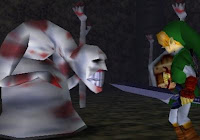

So, the reason I chose to put all of these dungeons is because all three are very similar to each other. They're all dealing with fighting various kinds of undead, they're all old, decrepit dungeons, they all have the same dark, claustrophobic feeling to them.
So, what makes this type of dungeon so scary? Like I said before, the claustrophobic feeling to them. The feeling that, around any corner, there could be monsters ready to strike, to kill. And, with the Arbiter's Grounds in particular, the idea that people HAVE died there. It was a prison, presumably with executions in it. And, even in the case of the other two, where do you think the undead creatures came from? Especially the worst of the lot, the biggest reason these dungeons are here: Redeads.
No matter what incarnation they are, these monsters never fail to utterly terrify me. That ear-piercing scream, followed by what can only be described as, well....
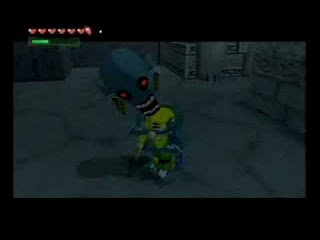
3. Earth Temple (Wind Waker) / Bottom of the Well (Ocarina of Time) / Arbiter's Grounds (Twilight Princess)


So, the reason I chose to put all of these dungeons is because all three are very similar to each other. They're all dealing with fighting various kinds of undead, they're all old, decrepit dungeons, they all have the same dark, claustrophobic feeling to them.
So, what makes this type of dungeon so scary? Like I said before, the claustrophobic feeling to them. The feeling that, around any corner, there could be monsters ready to strike, to kill. And, with the Arbiter's Grounds in particular, the idea that people HAVE died there. It was a prison, presumably with executions in it. And, even in the case of the other two, where do you think the undead creatures came from? Especially the worst of the lot, the biggest reason these dungeons are here: Redeads.
No matter what incarnation they are, these monsters never fail to utterly terrify me. That ear-piercing scream, followed by what can only be described as, well....

...Yeah. Not even the cartoony feel of Wind Waker's graphics make that any better. If anything, it might actually be a little worse here.
So, zombie fun times aside, these dungeons are a lot of fun, they're great, especially for those in need of a good scare.
Well then, with that, we are down to two parts. Be sure to come back tomorrow and Wednesday to find out the top two creepiest moments in video games.
Sunday, October 28, 2012
Month of Horrors: Kirby: Nightmare in Dreamland
So, as I discussed a few days back, Kirby is one of the most terrifying video game characters in existence. So I figured, what better to close out the reviews this month than a Kirby game?
Kirby: Nightmare in Dreamland is a 2002 remake of Kirby's first game, Kirby's Adventure. In it, you play as Kirby, who is trying to restore the Dream Rod, which has been shattered by King Dedede. He has to traverse across 7 different worlds in order to do so, beating Dedede's minions along the way.
When it comes to gameplay, I'd say this game is a little below-average, based off of my experience with later Kirby titles. In fairness, it is a remake of Adventure, but I don't feel like that means that HAL had to do a STRAIGHT adaptation of mechanics, which I get the impression is what they did. It's strange, I almost want to say that this game is both harder and easier than other Kirby titles. I felt like a died a lot more often while playing it, but it was also MUCH shorter. Like, maybe a couple hours. Honestly, I know their are extra modes, 100% completion, that kind of stuff that can lengthen gameplay, but the story itself only took me a couple hours to complete. The copy abilities are there as in any Kirby game, but they felt a little off to me. Abilities not doing things I remember them doing, doing things I don't remember, that kind of thing, and I'm sure that's just because I'm used to later games.
As you could tell from how short the synopsis was, this game does not have a lot in way of story. In fact, I didn't even realize what I was collecting until the last world. It kinda just throws you into the game and gives you the impression that you're supposed to go beat up a bunch of enemies on each level. And that's all their is to say there.
Now, I know that a lot of this can be defended by saying "Come on, it's a remake of an NES game, what do you expect?" To this, I say: Did you not see the thing I wrote on How I Review Games? I spelled out very clearly that, if you want to remake a game, that's fine, but make sure that it holds up to the standards of today. Or, 2002 in this case. And, honestly, I don't feel like it holds to those standards. Maybe Kirby's Adventure was a good game, I don't know, I never played it. But Kirby: Nightmare in Dreamland? I'd give it a pass.
Kirby: Nightmare in Dreamland is a 2002 remake of Kirby's first game, Kirby's Adventure. In it, you play as Kirby, who is trying to restore the Dream Rod, which has been shattered by King Dedede. He has to traverse across 7 different worlds in order to do so, beating Dedede's minions along the way.
When it comes to gameplay, I'd say this game is a little below-average, based off of my experience with later Kirby titles. In fairness, it is a remake of Adventure, but I don't feel like that means that HAL had to do a STRAIGHT adaptation of mechanics, which I get the impression is what they did. It's strange, I almost want to say that this game is both harder and easier than other Kirby titles. I felt like a died a lot more often while playing it, but it was also MUCH shorter. Like, maybe a couple hours. Honestly, I know their are extra modes, 100% completion, that kind of stuff that can lengthen gameplay, but the story itself only took me a couple hours to complete. The copy abilities are there as in any Kirby game, but they felt a little off to me. Abilities not doing things I remember them doing, doing things I don't remember, that kind of thing, and I'm sure that's just because I'm used to later games.
As you could tell from how short the synopsis was, this game does not have a lot in way of story. In fact, I didn't even realize what I was collecting until the last world. It kinda just throws you into the game and gives you the impression that you're supposed to go beat up a bunch of enemies on each level. And that's all their is to say there.
Now, I know that a lot of this can be defended by saying "Come on, it's a remake of an NES game, what do you expect?" To this, I say: Did you not see the thing I wrote on How I Review Games? I spelled out very clearly that, if you want to remake a game, that's fine, but make sure that it holds up to the standards of today. Or, 2002 in this case. And, honestly, I don't feel like it holds to those standards. Maybe Kirby's Adventure was a good game, I don't know, I never played it. But Kirby: Nightmare in Dreamland? I'd give it a pass.
Month of Horrors: The Creepiest Moments in Video Games Part 4
Well, here we are at the half-way point of this week. Now, today's entry is a little complicated. It is actually TWO moments, from two very different games. However, the moments I picked from both of these games happen to be very similar in tone, so I felt it appropriate to talk about both of them on the same day.
4. 2300 A.D. (Chrono Trigger) / The Future (Pokemon Mystery Dungeon: Explorers of Time/Darkness/Sky)

Now, what freaks me out about both of these is the idea of a ruined future. The idea that there will be some kind of apocalypse, and humanity (or... Pokemonity) will be left in shambles, trying vainly to survive in the hellhole that was once their home. In Chrono Trigger, there's this scene where the characters, who just fell through a time vortex to get there, realize that this place is their planet, 1300 years in the future. The fact that their world has gone so horribly wrong terrifies them, leading them to resolve to avert the catastrophe that led to this world. Of course, this decision had terrible consequences of its own, but that is a discussion for another day...

Likewise, in Mystery Dungeon, the characters are shocked to discover that this is their future. It's especially shocking since they had thought that they had been working to avoid this horrible future, where time has ground to a halt. But then they found out that they had been manipulated by an enemy who had wanted to preserve this dark future, and they had to, like the Chrono Trigger protagonists, resolve to make their way back to their own time and avert this disaster. Which, actually leads to similar consequences as Chrono Trigger, as it turns out...
Oh my God, Explorers is a partial remake of Chrono Trigger! Screw talking about this scary stuff, I'm going to go work on their theory! See you guys tomorrow for Part 5!
4. 2300 A.D. (Chrono Trigger) / The Future (Pokemon Mystery Dungeon: Explorers of Time/Darkness/Sky)

Now, what freaks me out about both of these is the idea of a ruined future. The idea that there will be some kind of apocalypse, and humanity (or... Pokemonity) will be left in shambles, trying vainly to survive in the hellhole that was once their home. In Chrono Trigger, there's this scene where the characters, who just fell through a time vortex to get there, realize that this place is their planet, 1300 years in the future. The fact that their world has gone so horribly wrong terrifies them, leading them to resolve to avert the catastrophe that led to this world. Of course, this decision had terrible consequences of its own, but that is a discussion for another day...

Likewise, in Mystery Dungeon, the characters are shocked to discover that this is their future. It's especially shocking since they had thought that they had been working to avoid this horrible future, where time has ground to a halt. But then they found out that they had been manipulated by an enemy who had wanted to preserve this dark future, and they had to, like the Chrono Trigger protagonists, resolve to make their way back to their own time and avert this disaster. Which, actually leads to similar consequences as Chrono Trigger, as it turns out...
Oh my God, Explorers is a partial remake of Chrono Trigger! Screw talking about this scary stuff, I'm going to go work on their theory! See you guys tomorrow for Part 5!
Friday, October 26, 2012
Month of Horrors: The Creepiest Moments in Video Games Part 2
So, today continues my countdown of the seven creepiest moments in video games. Now, this title is kind of a misnomer. As seen yesterday, they're not always IN video games, and as you'll see today, they're not always moments. In fact, today I'm going to be talking about one of the longer-running characters in video gaming history, who just celebrated his 20th birthday this year. So, let's get going with...
6. Kirby

6. Kirby
Now, I realize that this is hardly an original argument; hell, there have been songs written about the horror that is Kirby. But that hardly matters, so let's assume for a few minutes that you haven't heard these arguments in the past before.
Since you've never thought about it before, you're probably thinking, "But Flit, Kirby isn't scary! Look at him, he's adorable!" But I say in response, have you ever PLAYED a Kirby game? The little puffball is terrifying.
Let's look at this from the perspective of Kirby's enemies; or, half the time, random bystanders. They're minding their own business, when all of a sudden, this pink blob shows up and eats them alive. If they're lucky, he spits them back out as a projectile. If they're not? He swallows them, absorbing their essence. That is TERRIFYING. Even if they're trying to hinder his progress, that does not justify what Kirby does. Especially since he isn't even always in the right.
Let's talk about Kirby: Squeak Squad, which was in fact my first Kirby game. The game starts out with Kirby eating some cake, when suddenly, the cake is stolen. Kirby immediately goes to fight King Dedede over it, despite have NO EVIDENCE that Dedede has done anything wrong. And, in fact, Dedede hadn't done anything, but does that stop Kirby? NO. He just decides, "Oh, something bad happened to me. Better go beat up Dedede! ^_^"
So, yeah, Kirby: Black hole for a stomach, and no discretion as to what ends up in it. Seems perfectly fitting for the sixth creepiest thing in video games.
Wednesday, October 24, 2012
Month of Horrors: Penny Arcade Adventures: On the Rain-Slick Precipice of Darkness Episodes 1 + 2
So, the Month of Horrors continues tonight. Like my last review, this game may not exactly constitute 'horror.' In fact, given its origins and content, it's fairly clearly comedy. However, given the dealings with Old Ones present in this series, I do feel comfortable talking about this game in this month. Also, there are mimes. Mimes are scary, right?
So, odds are, if you're reading this, you've both been to the internet and enjoy games. If this is true, then you have likely seen Penny Arcade at some point in your life. But, if by some anti-miracle you haven't yet, allow me to explain. Penny Arcade is a ridiculously successful webcomic. It was started in 1998, and its creators, Jerry Holkins and Mike Krahulik, have made roughly fifteen quintillion dollars from it. It has spawned two conventions, a charity, an upcoming film based off of a one-shot comic, and three games, the first two of which I will be talking about today.
Penny Arcade Adventures: On the Rain-Slick Precipice of Darkness: Episode 1 and Episode 2*, were created by Hothead Games in 2008. Rather than taking place in the comic's universe, the game takes the characters from the comics, and places them in an original universe. You play as a character which you create. One day, while minding your own business**... your house is destroyed by a giant robot. Really an establishing moment for the game. Anyway, your character chases after two people that are chasing after the robot, and finds them to be detectives named Gabe and Tycho, who are investigating the robot. You decide to go with them in order to get revenge on the monstrosity, and so begins your adventures. However this goes far beyond what you expect. Dark silent forces are working in the shadows, attempting to summon their great Gods...
Gameplay wise, these games are... kind of reminiscent of Final Fantasy. Every battle begins with a roll for initiative. Whoever rolls the best will go first. As you wait for each of your characters' turns, they have three separate bars that fill up, each one starting after the last is full. The first to fill is items, which range from healing, changing stats, or damaging opponents. The next is your normal attack, which doesn't need any explanation. Finally, your special attack becomes charged. This is an attack that requires you to enter a particular button combination in order to deal massive damage to an opponent. If you do full damage and kill an enemy with it, you will gain an Overkill point. After collecting enough Overkill points, you gain a new special attack, which will do more damage, but requires a more difficult button combination. You also get up to 3 summons, which charge much more slowly, but also do a lot of damage. Overall, these games are not particularly hard to play, and are fairly enjoyable.
Graphically, this game is alright, nothing special, but not bad. Musically... I honestly don't remember the music. However, that's not what I want to talk about. I'd much rather talk about the writing.
This game was very obviously written by the lovely gentlemen responsible for Penny Arcade. The humor is very similar to the comic, for better or for worse. And yet... this game doesn't quite have the feel of Penny Arcade. The humorous parts are there, yes, but there's also a much darker setting here than in the comics. You are put into this world where Great Old Ones are being summoned, and it's up to you to stop them. Without spoiling much, both of these episodes conclude with a boss fight against an Elder God, and it's fairly fun to fight.
So, what do I think of these games, all in all? Well, as a fan of Penny Arcade, I feel that these are great games. There are some elements in episode two that were obviously supposed to be set-ups for episode three, as there were similar things in episode one that gave you rewards when the story was continued in episode two, but sadly, Hothead Games did not develop episode three, which only came out this summer, and so these elements were left unused. However, these two games are both fun, and would recommend them, especially if you enjoy the comic. Both are available on Steam, XBLA, and PSN.
So, now that I've finally gotten the Day of Three Reviews*** finished, be sure to come back next Sunday for my next review.
*Wow, that's a long title
**Why does nothing good come after that phrase anyway?
***Shut up.
So, odds are, if you're reading this, you've both been to the internet and enjoy games. If this is true, then you have likely seen Penny Arcade at some point in your life. But, if by some anti-miracle you haven't yet, allow me to explain. Penny Arcade is a ridiculously successful webcomic. It was started in 1998, and its creators, Jerry Holkins and Mike Krahulik, have made roughly fifteen quintillion dollars from it. It has spawned two conventions, a charity, an upcoming film based off of a one-shot comic, and three games, the first two of which I will be talking about today.
Penny Arcade Adventures: On the Rain-Slick Precipice of Darkness: Episode 1 and Episode 2*, were created by Hothead Games in 2008. Rather than taking place in the comic's universe, the game takes the characters from the comics, and places them in an original universe. You play as a character which you create. One day, while minding your own business**... your house is destroyed by a giant robot. Really an establishing moment for the game. Anyway, your character chases after two people that are chasing after the robot, and finds them to be detectives named Gabe and Tycho, who are investigating the robot. You decide to go with them in order to get revenge on the monstrosity, and so begins your adventures. However this goes far beyond what you expect. Dark silent forces are working in the shadows, attempting to summon their great Gods...
Gameplay wise, these games are... kind of reminiscent of Final Fantasy. Every battle begins with a roll for initiative. Whoever rolls the best will go first. As you wait for each of your characters' turns, they have three separate bars that fill up, each one starting after the last is full. The first to fill is items, which range from healing, changing stats, or damaging opponents. The next is your normal attack, which doesn't need any explanation. Finally, your special attack becomes charged. This is an attack that requires you to enter a particular button combination in order to deal massive damage to an opponent. If you do full damage and kill an enemy with it, you will gain an Overkill point. After collecting enough Overkill points, you gain a new special attack, which will do more damage, but requires a more difficult button combination. You also get up to 3 summons, which charge much more slowly, but also do a lot of damage. Overall, these games are not particularly hard to play, and are fairly enjoyable.
Graphically, this game is alright, nothing special, but not bad. Musically... I honestly don't remember the music. However, that's not what I want to talk about. I'd much rather talk about the writing.
This game was very obviously written by the lovely gentlemen responsible for Penny Arcade. The humor is very similar to the comic, for better or for worse. And yet... this game doesn't quite have the feel of Penny Arcade. The humorous parts are there, yes, but there's also a much darker setting here than in the comics. You are put into this world where Great Old Ones are being summoned, and it's up to you to stop them. Without spoiling much, both of these episodes conclude with a boss fight against an Elder God, and it's fairly fun to fight.
So, what do I think of these games, all in all? Well, as a fan of Penny Arcade, I feel that these are great games. There are some elements in episode two that were obviously supposed to be set-ups for episode three, as there were similar things in episode one that gave you rewards when the story was continued in episode two, but sadly, Hothead Games did not develop episode three, which only came out this summer, and so these elements were left unused. However, these two games are both fun, and would recommend them, especially if you enjoy the comic. Both are available on Steam, XBLA, and PSN.
So, now that I've finally gotten the Day of Three Reviews*** finished, be sure to come back next Sunday for my next review.
*Wow, that's a long title
**Why does nothing good come after that phrase anyway?
***Shut up.
Sunday, October 21, 2012
Month of Horrors: Plants vs. Zombies
So, here begins part two of today's three reviews. Once more, we discuss another game involving zombies. However, this time, the game is a bit less... dramatic.
Popcap's Plants Vs. Zombies was released on May 5th, 2009 for PCs and Macs and has been ported many, many times since. In it, you play as a person whose home is being attacked by zombies. Instead of using a gun or some other reasonable weapon, though, you choose to use various species of plants to combat the zombie horde. You have Peashooters, which, well, shoot peas at the zombies, Wallnuts, which block the zombies from advancing, Sunflowers, which provide sunlight to let you grow other plants, and many which you gain over the course of the game.
So, this plays like most other tower defense games. There are zombies on your lawn, and you don't want zombies on your lawn. So, you set up your plants in each of 5 rows of your lawn, and use them to keep the zombies from reaching your house. If ever the zombies get through your defenses, there is a lawnmower at the end of each row that will kill all of the zombies in that row once a zombie reaches it, but that only works once. If another zombie gets to the end of that row, you lose.
Graphically, musically, this game is okay. It isn't anything spectacular, but it isn't anything terrible either. It's cute*, but nothing in the game sticks out as particularly memorable.
Now, let me preface everything I'm about to say with this: I enjoy this game. It's a fun, lighthearted zombie tower defense game. I don't have any problems with its 'cutesy' graphics, the music isn't bad, the gameplay isn't too easy or too hard, I genuinely like this game.
However, I don't recommend buying it.
See, this is kind of what I don't get about Popcap in general. They put out games, free to play, online, and then offer, for want of a better term, better versions of the games to download for a fee. And, honestly, I just can't wrap my brain around how this works. Obviously it does work, Popcap has been fairly successful, but I just don't get it. Because I see two outcomes of using this system: Either a) the online version is enjoyable, in which case, why get the full version**; or b) the online version is not enjoyable, in which case, why would you want the full version? Now, obviously there's some third option I just don't understand, but for the life of me I can't figure out what it is.
So, ultimately, I recommend playing this game on Popcap's website, it is fun, but I wouldn't go out of my way to buy it if I were you.
Sorry this review is so short, this one was kind of spur-of-the-moment. But, be sure to stop by later today for the (not-so-)epic finale to this three-review day!
*You know, cutesy for zombies.
**I say this having bought the full version. Shut up, it was on sale.
Note: Yes, I am indeed counting this for Month of Horrors, even if it isn't scary. There are zombies in it, therefore it counts.
Popcap's Plants Vs. Zombies was released on May 5th, 2009 for PCs and Macs and has been ported many, many times since. In it, you play as a person whose home is being attacked by zombies. Instead of using a gun or some other reasonable weapon, though, you choose to use various species of plants to combat the zombie horde. You have Peashooters, which, well, shoot peas at the zombies, Wallnuts, which block the zombies from advancing, Sunflowers, which provide sunlight to let you grow other plants, and many which you gain over the course of the game.
So, this plays like most other tower defense games. There are zombies on your lawn, and you don't want zombies on your lawn. So, you set up your plants in each of 5 rows of your lawn, and use them to keep the zombies from reaching your house. If ever the zombies get through your defenses, there is a lawnmower at the end of each row that will kill all of the zombies in that row once a zombie reaches it, but that only works once. If another zombie gets to the end of that row, you lose.
Graphically, musically, this game is okay. It isn't anything spectacular, but it isn't anything terrible either. It's cute*, but nothing in the game sticks out as particularly memorable.
Now, let me preface everything I'm about to say with this: I enjoy this game. It's a fun, lighthearted zombie tower defense game. I don't have any problems with its 'cutesy' graphics, the music isn't bad, the gameplay isn't too easy or too hard, I genuinely like this game.
However, I don't recommend buying it.
See, this is kind of what I don't get about Popcap in general. They put out games, free to play, online, and then offer, for want of a better term, better versions of the games to download for a fee. And, honestly, I just can't wrap my brain around how this works. Obviously it does work, Popcap has been fairly successful, but I just don't get it. Because I see two outcomes of using this system: Either a) the online version is enjoyable, in which case, why get the full version**; or b) the online version is not enjoyable, in which case, why would you want the full version? Now, obviously there's some third option I just don't understand, but for the life of me I can't figure out what it is.
So, ultimately, I recommend playing this game on Popcap's website, it is fun, but I wouldn't go out of my way to buy it if I were you.
Sorry this review is so short, this one was kind of spur-of-the-moment. But, be sure to stop by later today for the (not-so-)epic finale to this three-review day!
*You know, cutesy for zombies.
**I say this having bought the full version. Shut up, it was on sale.
Note: Yes, I am indeed counting this for Month of Horrors, even if it isn't scary. There are zombies in it, therefore it counts.
Month of Horrors: The Walking Dead Episode 1
Before getting started, I'd like to apologize for not having posted anything last week. Complete oversight on my part, but I'm going to make it up today with not one, not even two, but three reviews. So, let's get this started with Episode 1 of The Walking Dead.
The Walking Dead originated as a monthly comic book series written by Robert Kirkman and drawn by Tony Moore, though Moore was replaced by Charlie Adlard after issue 6. However, it's likely that more people will be familiar with the AMC series based off of the comic, created by Frank Darabont. The comics and show focus on Rick Grimes, a Kentucky (Georgia in the show) sherrif's deputy. One day, he is shot in the line of duty, and ends up in a coma for a month. When he wakes, he finds the hospital abandoned, the only people remaining not quite people. These creatures appear human, but devour the flesh of the living, and cannot die unless their heads are destroyed. There's a word for these, but since they don't use it in-universe, I won't use it here. Rick eventually finds his family, and they, along with others, begin making their way across the land, attempting to find some sort of safety and survival.
Now, this is the premise of the show and comic. However, the game has little to do with this. In fact, it seems to be set during the month in which Rick is comatose. Instead, this game focuses on Lee Everett a professor at the University of Georgia. He begins the Apocalypse being taken out of Atlanta in a police car, having just been convicted of the murder of a state senator who had been sleeping with his wife, though Lee claims it was self-defense. Lee is talking to the officer driving the car when they hit a person, careening off the road. Lee blacks out, and when he wakes up, the car is wrecked, the cop is dead, and he must get out of his handcuffs and escape. But once he gets uncuffed, the cop... begins making his way towards Lee. Lee must kill the cop, and begin his attempt to figure out just what is going on anymore.
This is an adventure game, focusing on Lee as he attempts to survive the horde of... walkers, as the show calls them. Lee must find items, and use them to solve puzzles. He also has to interact with numerous other survivors. This actually includes cast members from the show/comic, such as Hershel Graham and Glenn, before they meet Rick. Although, I won't lie, my favorite character is probably Clementine. It's cheap, but adding a child to protect is a good way to get someone invested in a game. It makes me worried that they're going to build up the relationship between Lee and Clementine, only to have something horrible happen to her down the road. Not going to lie, I'll be REALLY angry if that happens.
Graphically, I like this game. From what I've seen, it's similar to what Telltale did with Back to the Future and Jurassic Park, but this one feels more... comic-booky. It's sort of hard to describe, but it feels like these characters actually came out of a comic book. It's really fitting for this game, and I have enjoyed it.
Musically... I have nothing to say. I honestly cannot remember if there even WAS any music, much less what it sounded like. I feel, though, that this works for this game. It gives this feeling of isolation, which really works in a game where you're struggling for survival. I'll take this time, instead, to talk about the voice acting. I really enjoy it. I wish they'd gotten the actors for Glenn and Hershel from the show to voice their characters, but I understand that they probably busy, or Telltale couldn't afford it, or something. Overall, though, I thought the VAs did a good job. I felt comfortable with the characters, and genuinely wanted to help them survive. Except for the assholes, who are still fairly well-written. And then one of the assholes may have been set up as a romantic interest. That was kinda weird...
But yeah, overall, Episode 1: A New Day was enjoyable, and I'll definitely play the rest of them. In fact, Telltale recently announced that they are going to be making a second season of the game, and if the rest of this season is like this episode, I'll certainly plan on getting it.
So, here ends the first review of the day. Be sure to come back later for the next two parts.
Wednesday, September 5, 2012
Pokemon Conquest
So, here's my next review. I suppose I should say this up front: I'm pretty sure I'm some kind of Pokemon fanboy. I have owned just about every game since Crystal, even some that I really regret (Long story short, since I'll probably never review it: Don't buy Pokemon Dash. Ever. It's not good). I'm also a fan of Turn-Based Strategy games, particularly the Fire Emblem series (I'll probably end up reviewing a couple of these at some point in the future. They are good). So, when I found out that there was going to be a Pokemon-based TBS game, I was pretty excited. So, with that out of the way, let's get started with Pokemon Conquest.
Pokemon Conquest, known as Pokemon + Nobunaga's Ambition in Japan, is something like the 20th Pokemon spin-off game, and also something like the 26th game in the Nobunaga's Ambition franchise. It is a crossover between the Pokemon and Nobunaga's Ambition series, or, rather, a game in the Nobunaga's Ambition franchise with Pokemon. It's the first Nobunaga's Ambition game released in America, and if it sells half as well as most Pokemon games, it will likely not be the last.
In Conquest, you play as the Warlord of the Aurora kingdom in the Ransei region. A warlord from the far North, Nobunaga, has begun conquering the other kingdoms, in hopes of fulfilling a legend that whosoever rules all 17 kingdoms will gain the power of the creator of the region. You decide to try to conquer the region yourself, in order to stop whatever Nobunaga might be planning.
Gameplay wise, Conquest is pretty standard for Turn-Based Strategy games, at least standard for the ones I've played. You control various warlords and warrior, each bonded to a Pokemon, and fight off wild Pokemon and other warlords. If you defeat a warlord, and fulfill a few other requirements, the warlord can join your team. Your warlords can also form bonds with wild Pokemon, having them join that particular warlord, though each warlord can only have so many Pokemon at a time. In battle, all of your warlords make their moves, and then all of your opponents make their moves. This repeats until somebody wins the battle.
Story wise, this game is nothing special. Basically, it's a standard Pokemon game. You have to get through the 17 kingdoms/gyms, defeating the warlords/gym leaders, adding new Pokemon to your team as time goes on. Honestly, nothing more to say here. The characters that join your team, even discounting the generic warriors, don't really have anything that distinguishes them. Honestly, this game kind of falls flat here. I really enjoyed the story in Black/White, with its examination of whether or not it's right to train Pokemon. And then this is just... blah. It's not bad, it's not good, it barely even is.
At about this point in the last two reviews, I went over something that really stuck out to me in the game, for good or bad, like the Drop mechanic and Flick Rush in Kingdom Hearts 3D, or the narration and soundtrack in Bastion. This time, though... there's nothing. Nothing in this game really stuck out to me. As a Pokemon game, it doesn't do anything new besides be a Turn-Based Strategy game, and as a Turn-Based Strategy game, it doesn't doesn't do anything new besides have Pokemon. I suppose the simple combination of these two does enough to justify the game, but at the same time, there's nothing that gets an emotional response from me. It feels like it should be something that I should like, and yet, I don't really feel anything for it. I don't hate it, but at the same time, I didn't really like it either.
So, do I recommend this game? No. No I don't. It's not that it's bad, it's just boring. If you're a huge enough fan of Pokemon, you'll probably get this game anything, so I hope you enjoy it. But I can't suggest someone get this game otherwise. It's a nice enough time-waster, but that's about it.
So, when I first started this whole review thing, I said that I was going to mostly review older games. But here we are at review three, and all of my reviews thus far have been games released in the last year. But now, we finally come to something just a little bit older. So, be sure to come back next week for Mario & Luigi: Superstar Saga.
Pokemon Conquest, known as Pokemon + Nobunaga's Ambition in Japan, is something like the 20th Pokemon spin-off game, and also something like the 26th game in the Nobunaga's Ambition franchise. It is a crossover between the Pokemon and Nobunaga's Ambition series, or, rather, a game in the Nobunaga's Ambition franchise with Pokemon. It's the first Nobunaga's Ambition game released in America, and if it sells half as well as most Pokemon games, it will likely not be the last.
In Conquest, you play as the Warlord of the Aurora kingdom in the Ransei region. A warlord from the far North, Nobunaga, has begun conquering the other kingdoms, in hopes of fulfilling a legend that whosoever rules all 17 kingdoms will gain the power of the creator of the region. You decide to try to conquer the region yourself, in order to stop whatever Nobunaga might be planning.
Gameplay wise, Conquest is pretty standard for Turn-Based Strategy games, at least standard for the ones I've played. You control various warlords and warrior, each bonded to a Pokemon, and fight off wild Pokemon and other warlords. If you defeat a warlord, and fulfill a few other requirements, the warlord can join your team. Your warlords can also form bonds with wild Pokemon, having them join that particular warlord, though each warlord can only have so many Pokemon at a time. In battle, all of your warlords make their moves, and then all of your opponents make their moves. This repeats until somebody wins the battle.
Story wise, this game is nothing special. Basically, it's a standard Pokemon game. You have to get through the 17 kingdoms/gyms, defeating the warlords/gym leaders, adding new Pokemon to your team as time goes on. Honestly, nothing more to say here. The characters that join your team, even discounting the generic warriors, don't really have anything that distinguishes them. Honestly, this game kind of falls flat here. I really enjoyed the story in Black/White, with its examination of whether or not it's right to train Pokemon. And then this is just... blah. It's not bad, it's not good, it barely even is.
At about this point in the last two reviews, I went over something that really stuck out to me in the game, for good or bad, like the Drop mechanic and Flick Rush in Kingdom Hearts 3D, or the narration and soundtrack in Bastion. This time, though... there's nothing. Nothing in this game really stuck out to me. As a Pokemon game, it doesn't do anything new besides be a Turn-Based Strategy game, and as a Turn-Based Strategy game, it doesn't doesn't do anything new besides have Pokemon. I suppose the simple combination of these two does enough to justify the game, but at the same time, there's nothing that gets an emotional response from me. It feels like it should be something that I should like, and yet, I don't really feel anything for it. I don't hate it, but at the same time, I didn't really like it either.
So, do I recommend this game? No. No I don't. It's not that it's bad, it's just boring. If you're a huge enough fan of Pokemon, you'll probably get this game anything, so I hope you enjoy it. But I can't suggest someone get this game otherwise. It's a nice enough time-waster, but that's about it.
So, when I first started this whole review thing, I said that I was going to mostly review older games. But here we are at review three, and all of my reviews thus far have been games released in the last year. But now, we finally come to something just a little bit older. So, be sure to come back next week for Mario & Luigi: Superstar Saga.
Wednesday, August 29, 2012
Bastion
And here we are with my second ever review. If you’ve read my last one, welcome back. If you haven’t, then have a seat and make yourself comfortable. Yes, that does mean that if you read the last one, you aren’t allowed to be comfortable. Deal with it.
This time around, I’ll be looking at the game Bastion. This game was released last year on Steam and Xbox Live Arcade, and earlier this year on the Mac App Store. Bastion tells the story of The Kid, a survivor of The Calamity in his home of Caelondia. The Kid then begins a journey to find pieces of Core, a substance that is keeping the remaining few parts of land in existence. He brings these pieces of Core back to The Bastion, which he then uses in order to expand it. But as he learns more about what caused the Calamity, the lines of who's right and wrong being to blur, and an army seeking retribution begins to rise...
Gameplay-wise, this game is pretty easy to play. You move with the arrow keys, and have two weapons, one assigned to each of the mouse buttons. You can change which weapons you have equipped at Arsenals, scattered infrequently across the levels, as well as in the Bastion, the game’s hub. By the end of the game, you’ll have eleven different weapons from which to choose, ranging from the basic Cael Hammer to the insanely destructive (and fun) Galleon Mortar, which, for those of you who can’t or won’t do the math, gives you a total of fifty-five different potential weapon combinations to fight off your foes. As you gain experience from fighting enemies, you gain new slots in the Distillery in the Bastion, allowing you to equip drinks with groan-inducing pun names, like Stabsinthe, which damages enemies when they damage you, or Hearty Punch, which gives you another chance to continue should you run out of health. Should you run out of health without any continues remaining, you’ll be sent back to the Bastion, and have to repeat the entire level. However, this only happened to me one or two times, and the levels aren’t ridiculously long, so it isn’t overall that annoying. As far as gameplay goes, this game doesn’t really do anything particularly innovative. In all honesty, it’s the story where this game shines.
This story is certainly different from the standard game. Nowhere in this game is there anything resembling the basic ’stop the Big Bad from destroying/taking over the world,’ because in Bastion, the world has already been destroyed. You’re not trying to save the world, you’re trying to build a new one from the scraps of the original. There’s no real antagonist in this game, just other groups trying to survive, just like you. There’s this one point in the game where you find a piece of Core that has been claimed by a group of monsters. These monsters have banded together, using the Core to form their own Bastion of sorts. It becomes a bit of conflict for the player as to whether or not its right to take this piece of Core and destroy their home just to improve yours.
At this point I’d like to go off on a slight tangent and talk about the narrator. Rucks, played by Logan Cunningham, a man who has not had nearly enough roles if you ask me, narrates about everything. No, seriously, everything. Every event, he’ll be giving a play-by-play. You remember how I mentioned earlier that the game gives fifty-five different weapon combinations to use? Yeah, Rucks has a different comment for each and every one of them. Any item you find in the game? Take it to him in the Bastion, he’ll have something to say about it. Any building you build, achievement you gain, challenge you overcome, he’ll say something. Say you fall to your death, (which will happen, apparently the Cataclysm was especially unkind to walls) he’ll give you snark about it. Just the sheer amount of recording this man did is impressive, and the quality of the lines is a credit to both the actor and the writer.
Something else that strongly deserves mentioning in this game is the music. This wasn’t something I went over last week in Kingdom Hearts 3D, but I need to talk about it here. The music in this game, simply put, is great. I was lucky enough to decide to get the Soundtrack Edition of the game, which, as it sounds, is both the game itself and a copy of the soundtrack. This is not a decision I regret. Darren Korb did a great job composing the songs, writing the lyrics for a few tracks, and even recording vocals for two songs. So, if you are a music lover, I would recommend getting the soundtrack with the game. And even if you don’t, as long as you have the game, you can still get the soundtrack later. It’s just that Steam, for whatever reason, won’t let you get the soundtrack unless you have the game. Seems strange to me, but there you go.
Now, my last word. Do I recommend this game or not? Well, really, this should seem like a fairly obvious answer: Yes. Yes I do. Immensely. Seriously, why are you still reading this? You obviously have a computer with an internet connection. Go onto Steam, find this game’s page, hit the ‘Add to Cart’ button, pay for the game, download it, and then play it. Unless you’re some kind of crazy bizarro-person, you will almost certainly enjoy this game.
As a final side note, if you do get this game on Steam, once you’ve beaten the game, be sure to start a New Game Plus and play through until you build the Arsenal for a special treat.
So, this concludes my second review. I hope you’ve enjoyed it, and be sure to come back next week, when I review something very different, a bit more mainstream, and from a series just a little bit closer to my heart: Pokemon Conquest.
Wednesday, August 22, 2012
Kingdom Hearts 3D
So, if you’re reading this, I guess the first thing I should say is ‘Hello.’ I’m Flitterbie, and this is From One Nerd to Another. A few weeks ago I decided that wanted to try doing video game reviews. I'm not sure that I'm going to be any good at it, and I'm not even sure that this is the best place to even be doing it, but I figured I'd give it a shot anyway. My basic plan is to have a new review of a different game up every week. Now, most of the games I'm going to be reviewing are probably going to be a little bit older, simply because I don't have the budget to keep buying new games. However, my first game is a new one, having just come out three weeks ago: Kingdom Hearts 3D: Dream Drop Distance.
Kingdom Hearts 3D: Dream Drop Distance is the eighth title in the Kingdom Hearts franchise, which just celebrated its tenth anniversary in March. For the five or so people on the internet not already at least vaguely familiar with this series, it is a creation of both Square Enix and Disney, featuring an original character traveling across numerous worlds, usually based off of Disney movies, and fighting monsters in these worlds with a Keyblade, a weapon in the shape of a, well, key which can be used to open any lock, even if that lock is really more metaphorical, like the lock on a person‘s heart. Kinda cheesy at times, but an all-around fun series, especially when you get to have boss fights against Disney villains you especially loved to hate. This time around, the player controls both Sora, the main protagonist of the series, as well as Riku, childhood friend and one-time antagonist of Sora.
At the beginning of this game, Sora and Riku are told by Master Yen Sid (of ‘The Sorcerer’s Apprentice’ in the 1940 film Fantasia) that they must undergo a Mark of Mastery Exam in order to be considered true Keyblade Masters. In this case, their exam in to visit seven ‘sleeping’ worlds, worlds that were at one time lost to the darkness and have yet to return. In these worlds, they must find and unlock the seven Sleeping Keyholes, and therefore allow the worlds to re-awaken. As they journey through these worlds, however, they encounter past foes they had thought defeated, as well as a new face: a young man in a dark coat who seems to have ill intent for both. It looks as though Sora and Riku will have a much harder time passing this exam than Master Yen Sid ever intended…
Now then, on to gameplay. 3D has a fairly similar control scheme to Kingdom Hearts Re:coded, the last title in the series. Some new additions, however, lie in the Flowmotion, Reality Shift, and Dream Eater mechanics. Flowmotion is a new means of both getting around and fighting. You dash into, or in some cases, jump onto, various objects, such as walls, poles, or railings, and it allows the player to gain a huge burst of speed. In addition to this, you can also use it for special attacks, doing much more damage than your normal attacks would.
Reality Shift is a special kind of attack that changes depending on the world you’re in. It can be activated occasionally on enemies as you do damage to them, and can also be used on certain objects found in the game. All of these abilities use the touch screen. For example, in Traverse Town, you can use the Sling Shot to aim and catapult enemies at each other. In Country of the Musketeers, the world based of 2004’s Mickey, Donald, Goofy: The Three Musketeers, you can use Wonder Comic to follow instructions to cause your enemy to launch out of the bottom screen, causing damage to all surrounding foes. When done properly, all Reality Shifts will eliminate the enemy directly attacked, and will likely deal a good bit of damage to enemies around them as well.
The Dream Eaters are both enemies and allies in the game. The first kind of Dream Eater you encounter are Nightmares, dark Dream Eaters that are explicitly stated to be the sleeping worlds’ equivalent of the Heartless. However, as you fight the Nightmares, you find Dream Pieces, which you can then combine to create Spirits, friendly Dream Eaters that will help you fight the Nightmares. Each Spirit has an Ability Grid, which contains various Commands and Abilities for you to use. This can be anything from a basic Fire spell to the incredibly useful Once More ability. You start at one spot in the ability grid, and work your way outwards towards better abilities by spending Link Points, which you gain by fighting and bonding with your Spirits. As your Spirits fight with you, their Link Gauges also fill up. When the Link Gauge is full, you can activate it to combine the Spirit’s power with Sora/Riku. For Sora, this manifests as a powerful combination attack, whereas for Riku, the Spirit adds its strength to his own, increasing his damage output as well as adding an element to the damage he deals.
Now, since this is supposed to be a review, I suppose I should be giving my opinions, rather than just summarizing. Overall, I like this game. Gameplay-wise, it’s fairly simple to learn, and the mechanics make the game a fair bit more enjoyable than other titles in the series. When it comes to my opinion on the story, well, that gets a little more complicated. As far as adapting the Disney movies into worlds goes, I’m a little conflicted. I’ve never seen The Three Musketeers, so I can’t comment on how well that gets adapted into this game. On a similar note, Fantasia didn’t really have much of a story to translate into the game, at least in my memory, so that world gets a pass too. The Hunchback of Notre Dame, on the other hand, is probably my favorite Disney movie, and so I’m a little less lenient on how its story is told in the game. Honestly, I felt like it wasn’t the best adaptation. Having seen the movie, I understood what was happening in the cut scenes, but I got the feeling that if someone hadn’t seen Hunchback, they likely would’ve had a harder time with it. There are a couple of scenes towards the end of the world that seems to come out of nowhere in this game, though it made sense when seen in the movie. I thought that The Grid, based off of Tron: Legacy, however, did a good job of adapting that movie in Riku’s story. And anyone who’s seen Legacy and played Kingdom Hearts II can probably make a guess as to what happens in Sora’s story, and I thought that was done well also. The overarching story is rather complex, taking in a lot of elements from earlier titles, likely in an attempt to show how everything is wrapping up in time for the Grand Finale in Kingdom Hearts III. However, the game does include a ’Chronicles’ feature, providing summaries of the other Kingdom Hearts games as they become relevant to the plot. For that reason as well as the quality of the gameplay, I’d say that, though this is one of the more complicated stories in the series, it’s also probably a good jumping-in point for anyone interested in checking out this series.
One other thing I should mention is the Flick Rush minigame. In this game, you take the three Spirits that currently form your party and have them compete against three other Spirits either controlled by the AI or by another player over local wireless. Each Spirit has 15 cards, which can be used to heal, attack, etc. by flicking them upwards on the touch screen, or to defend against enemy attacks by flicking them downwards. Each card has a numeric value. You can add card values together by quickly flicking multiple cards, adding their value to the first card flicked. If your card has a higher value than your opponent’s, and their attack hits you, then they are stunned, leaving them vulnerable to another attack. The goal is to defeat all three of your opponent’s Spirits, and based on your performance, you are awarded some number of medals, which can be redeemed for items. This game is really addictive. On multiple occasions, I found myself having to say “Okay, keep playing until you lose, but then get back to the actual game.”
Now, I know I’ve said a lot of good things about this game, but I did have one problem with it: the Drop mechanic. As you play through the game, you have the option of switching between Sora and Riku at any time as they go through their independent stories. However, if you play as one character for a certain amount of time, the game will automatically switch you over to the other character. You can then immediately switch back to the character you were playing as, but as you fight Nightmares, you gain Dream Points, which you can spend upon Dropping to gain power-ups, like increases to your stats, making it easier to bond with your Spirits, and even making it take longer before you Drop again. These power-ups last until the next time you Drop, so if you keep switching back to the same character over and over, you’ll never be able to take advantage of this. I like this mechanic in the context of the story, since it encourages playing as both characters at roughly the same rate, but in terms of gameplay, I hate it. The Drop can happen at any time, so on multiple occasions, I had my character Drop IN THE MIDDLE OF A BOSS FIGHT. And then when I’d get back to that character, the boss would be back at full health, and I‘ve have to start all over again. Now, Square, I like you guys, you've made some great games, and if you want to have two protagonists in the same game, that’s fine. If you want their stories to be played simultaneously, that’s fine too. But if you want to force the player to switch characters at fixed intervals, DON’T ALLOW THE CHARACTERS TO SWITCH DURING BATTLES. Before this, I thought that nothing was more irritating than having to re-start a boss fight because the boss got off a cheap shot. Now, I realize this isn’t true; what’s more irritating is having to re-start a boss fight because the game decided ‘Oops, sorry, you took too long!’ Here's a crazy idea: maybe instead of having the characters switch after playing for a certain amount of time, how about having them switch based on how far they get in the story? So, you play as Riku for a while, get to cutscene, maybe have a little plot twist or cliff-hanger, and THEN switch to Sora until he gets to a good place in his story to stop for a while. That way, you have the characters proceeding through their stories at the same rate, and you don't have me needing to repeat boss fights because of a stupid mechanic.
But, in all honesty, the Drop mechanic was probably my only real problem with the game overall. Pretty much everything else that comes to mind, I either didn’t mind, or actively enjoyed. So, all in all, I would say that Kingdom Hearts 3D is definitely worth picking up if you’ve enjoyed the other games in the series. If you’ve never played Kingdom Hearts before, then I would say that this would probably be a good place to start playing, as the Chronicles will fill you in on anything you’ve missed. However, if you have played Kingdom Hearts before, and just didn’t enjoy it, I doubt that this game will change your opinion of it.
So, this wraps up my first review. If you didn’t enjoy it, well, doesn’t matter to me all that much. However, if you did like it, feel free to leave a comment. Maybe an idea of what you think I could do better, maybe a suggestion for another game to review, maybe just praise of my glory, whatever. And be sure to keep an eye out for my next review, which should be up next week, where I'll be talking about Bastion.
Subscribe to:
Posts (Atom)